Apr 16, 2026
Strategy Bulletin Vol.398
Mr. Market Justifies Trump’s Unconventional Strategy
~Confused Media, Experts, and Commentators~
(1) The Extreme Discrepancy Between the Media and Experts’ Chorus of Criticism Against Trump and the Steady Market
Media, experts struggling to keep up with the unconventional Trump
Amid the chorus of criticism against Trump, the U.S. stock market (S&P 500 Index), which had fallen 8% following the February 28 airstrike on Iran, fully recovered by April 13 and has rebounded to within 1% of an all-time high. Crude oil futures prices are also hovering in the high range, with near-term contracts at $90–110 per barrel, while six-month contracts have settled in the $70 range. The market is clearly not anticipating sensational scenarios such as a long-term blockade of the Strait of Hormuz or a third oil shock. Although the dollar typically strengthens in times of crisis, the Dollar Index has remained within a narrow range of 98 to 100 points throughout this period. While U.S. long-term interest rates rose to between 4% and 4.5% due to inflation concerns, they returned to the 4.2% range on April 15—the median level over the past year.
The market sees an opportunity in the Trump strategy
How should we reconcile this market stability with the chorus of pessimism being touted by the media and experts? To put it bluntly, the media and experts simply cannot keep up with the Trump administration’s relentless barrage of wildly unconventional policies. However, financial markets, grounded in realism, view the Trump administration’s series of policies as unlikely to hinder the business environment—and indeed, they foresee a potentially bright near future. There is no need to reiterate the pessimism and criticism of Trump’s policies from experts and the media. What needs to be explained now is the realism that the market perceives. Let me dare to cast myself as Mr. Market and justify the market’s logic.
(2) The Strait of Hormuz blockade will not last; crude oil prices will eventually fall
Blocking the Strait of Hormuz is a desperate move
First, the blockade of the Strait of Hormuz will not be prolonged, and crude oil prices will return to the $60–70 range seen before the attack on Iran within six months to a year. The crude oil futures market has entered a state of complete backwardation, and expectations of falling prices are taking hold.
To begin with, the share of crude oil in the primary energy mix of major countries has halved over the past 50 years, and the U.S. shale revolution since the mid-2010s has made the U.S. the world’s largest oil producer. The U.S. is now a net exporter of fossil fuels (with an annual trade surplus of approximately $100 billion), and its dependence on the Middle East for energy has declined significantly. Incidentally, Japan’s dependence on oil for its energy needs has also fallen from 76% during the first oil shock in 1973 to 40% in 2010 and 35% in 2024. The Strait of Hormuz, through which 20% of crude oil supplies pass, has thus seen its importance to the global economy significantly diminish.
With alternative routes available—such as the Saudi East-West Pipeline and the pipeline from the UAE to the Arabian Sea—that bypass the Strait of Hormuz, even a prolonged blockade would not have enough impact to trigger a global recession.
U.S. Control of the Strait of Hormuz Is a Nightmare for Iran and China
More importantly, a blockade of the Strait of Hormuz would benefit no one. The strait is a lifeline not only for Gulf states such as Saudi Arabia, Qatar, and the UAE, but also for Iran. For Iran, which is under economic sanctions, trade with China via the Strait of Hormuz is particularly vital. It is estimated that 90% of Iran’s crude oil exports go to China, and that Iran also procures manufactured goods—including military equipment, energy-related facilities, and dual-use technology products—from China via the Strait of Hormuz, which are subject to embargoes by liberal democracies.
If U.S. attacks on Iran intensify and control of the Strait of Hormuz shifts to the United States, it would be tantamount to cutting off Iran’s lifeline. Furthermore, the defection of countries under China’s influence—such as Venezuela and Iran—will lead to a decline in China’s international presence. Iran’s policy of holding the Strait of Hormuz hostage is a desperate move akin to “a cornered rat biting the cat,” and one that cannot last long. It is highly likely that we will hear good news about the liberation of the Strait of Hormuz before Trump’s visit to China on May 14.
(3) The Era of U.S.-China Coexistence Beginning with Trump’s Visit to China
The Humiliation of TACO
Following the expected ceasefire in Iran and the liberation of the Strait of Hormuz, the global geopolitical landscape is expected to undergo a drastic transformation. This shift is driven by changes in the U.S.-China power balance. By the end of 2025, China had been strengthening its dominance. The Trump administration’s plan to raise tariffs by 145% crumbled in the face of China’s threat to ban rare earth exports. Trump became known as TACO (Trump Always Chickens Out), adopting a weak stance and elevating China to the status of a “special nation” that would lead the world alongside the U.S., referring to the U.S.-China relationship as the “G2.” Trump’s visit to China, scheduled for April, was viewed as a “begging trip” aimed at securing expanded imports of U.S. agricultural products and an extension of the one-year limit on rare earth supplies. The cards were entirely in China’s hands.
The Trump Administration Regains the Upper Hand Against China
However, through the spectacular invasion of Venezuela and the abduction of President Maduro, as well as the airstrikes on Iran and the assassination of its leader—all carried out since the beginning of the year—the U.S. demonstrated the height of its military power and mobility. Furthermore, it drew economically bankrupt dictatorships under China’s influence, such as Venezuela and Iran, into the U.S. sphere of influence. In the National Security Strategy (NSS) released late last year, the U.S. stated that while it does not seek regime change in other countries, it is absolutely determined not to allow China to alter the status quo using its power.
Taiwan become the lifeline of the U.S. economy
Of particular note is the growing importance of Taiwan to the United States. Figure 1 shows the trend in the U.S. trade deficit by country on an annual and quarterly basis. On an annual basis, the deficit with China has plummeted, while deficits with Mexico and Vietnam—countries to which China is shifting manufacturing operations—have surged. However, on a quarterly basis, the U.S. trade deficit with Taiwan has surged dramatically, and since the start of this year, Taiwan has become the United States’ largest source of trade deficit. The reason is the rapid increase in exports of Taiwanese AI-related products to the U.S., led by TSMC. The U.S. now relies entirely on Taiwan for its high-tech hardware, particularly AI-related hardware, and this trend is expected to strengthen further. Taiwan has now grown to the point where it holds the lifeline of the U.S. economy. The U.S. can no longer afford to let Taiwan go.
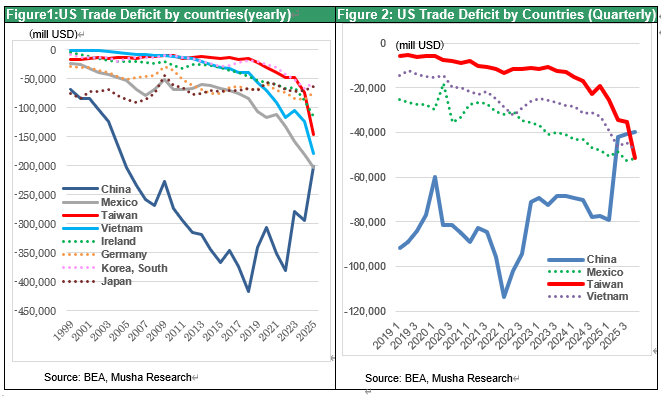
Figure1:US Trade Deficit by countries(yearly) Figure 2: US Trade Deficit by Countries (Quarterly)
Having witnessed U.S. belligerence toward Venezuela and Iran, China finds itself in a situation where an invasion of Taiwan is impossible unless it is prepared for all-out war with the U.S.
Trump’s visit to China starting May 14 will see negotiations unfold under a sudden shift to U.S. superiority. Are we entering an era where the U.S. and China, while pointing guns at each other, pay lip service to superficial cooperation and coexistence? As adversaries who cannot share the same sky but also cannot defeat one another, they will pursue economic coexistence. For the Trump administration, improving the economic environment ahead of the November midterm elections is essential, while for China, economic recovery is an urgent priority amid a bursting bubble, advancing deflation, and fragile domestic demand.
U.S.-China Economic Cooperation Is a Positive Factor for Stock Prices
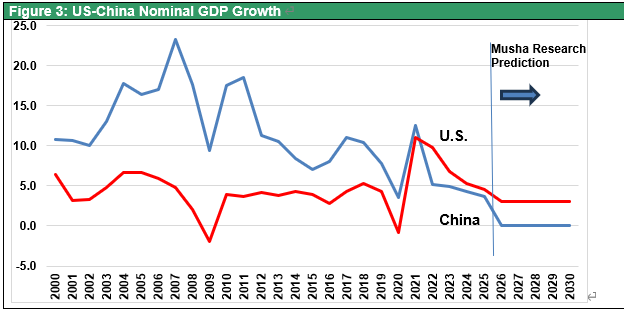
With the bursting of its economic bubble still only halfway complete, China will be forced to endure an economic slump for the near future. Since 2022, China’s nominal economic growth rate has consistently lagged that of the United States. The economic gap between the two countries is likely to continue widening. The Trump administration will curb China’s quest for hegemony through a protracted struggle under a framework of U.S.-China coexistence.
The confirmation of this US-China coexistence framework—however superficial—is likely to be positive for the global economy and markets in the near term. It will serve as a tailwind, driving stock price gains in the second half of the year.
Figure 3: US-China Nominal GDP Growth
(4) The Trump Administration’s Major Shift in Policy Toward China (From Strategy Bulletin
No. 376, April 1, 2025)
From Regime Change to Peaceful Coexistence
Since the beginning of the 21st century, the U.S. policy of engagement toward China has created a massive imbalance—namely, “industrial power without demand” (the “monster” known as China).
How should we deal with this China? A neoconservative approach—such as applying pressure on China to transform its Communist Party dictatorship—is no longer feasible. Given that neoconservative leaders like John Bolton and Mike Pompeo, who handled foreign policy and national security in the first Trump administration, were not appointed, it appears the second Trump administration has shifted its course toward the realist camp.
Realism: Deterrence and Coexistence with China
If the era of coexistence with China will continue, a strategy to contain China over the long term will require a policy of “China containment” like George F. Kennan’s policy of containing the Soviet Union. While Kennan denounced the Soviet Union as a force that 1) fanatically believed it was desirable to destroy the harmony of American society, crush its way of life, and bring down its authority in order to ensure its own stability, he also argued that 2) unlike the Nazis, the Soviets did not take risks, thus suggesting the possibility of coexistence. So, what about China today?
Elbridge Colby, often described as the “modern Kennan,” has taken a central seat in U.S. military strategy as Under Secretary of Defense. In his book *Asia First: A New American Military Strategy*, Colby argues that 1) China is the greatest threat and all resources must be redirected to Asia; 2) China must be deterred from altering the status quo—such as through an invasion of Taiwan—and from resorting to the use of force; and 3) regime change in China is not sought. The strategy entails making Xi Jinping realize the prohibitive cost of military action to deter him from taking preemptive action, while avoiding cornering China and maintaining coexistence.
The reckless use of military force against Venezuela and Iran can also be viewed as a new development in this Colby strategy.