Aug 02, 2026
Strategy Bulletin Vol.405
Strong U.S. Support for Takaichi; Ceiling in Sight for the Dollar-Yen Rate
~ Criticism toward Takaichi Economic Policies will fade ~
- cordinated intervention has historically reversed exchange rate trends. There is a strong possibility that this latest coordinated intervention by Japan and the U.S. will also be successful, forming a ceiling at 160 yen per dollar.
- However, this intervention was aimed at irrational speculation, and neither Japan nor the U.S. is seeking a reversal of the exchange rate trend. The U.S. needs a strong dollar to sustain capital inflows into the country and keep long-term interest rates in check. Japan needs to maintain a weak yen to strengthen competitiveness, expand investment, and sustain healthy inflation.
- If the yen’s depreciation stops, the need for interest rate hikes will disappear, and Japan’s long-term interest rates will likely stabilize at just under 3%. The “Honebuto Shock Theory” (the criticism that the “Honebuto Policy” is causing a national crisis of yen depreciation and rising interest rates) will no longer hold water. The Takaichi administration’s proactive economic policies—such as reducing the consumption tax on food to 1%—will become significantly easier to implement. The U.S.’s coordinated intervention will provide significant support to the Takaichi administration.
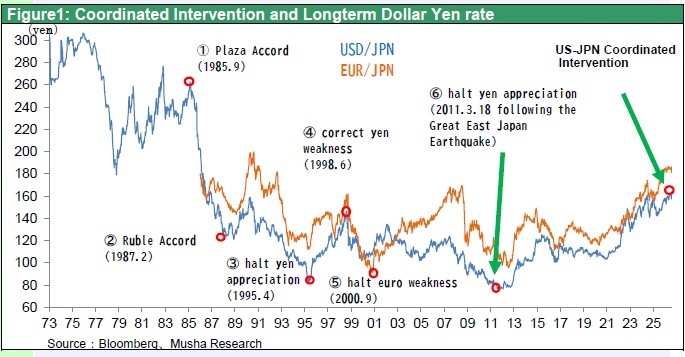
Unexpected Coordinated U.S.-Japan Intervention to Halt Yen Weakness
The dollar-yen exchange rate, which had surged to 163.9 yen in the middle of last week, plummeted starting shortly after 10:00 p.m. on Thursday, July 30, closing at 157.61 yen in the New York market on Saturday, August 1, at 6:00 a.m. Japan time. In tandem with the Japanese government and the Bank of Japan’s intervention to sell dollars and buy yen, U.S. authorities also appear to have taken steps to intervene by selling euros and buying yen. The scale of the intervention on July 30 is estimated to have been between 6 trillion and 7 trillion yen. Combined with the 11.7 trillion yen in interventions from late April to late May, the total reached 18 trillion yen, surpassing the previous record of 15.3 trillion yen set in2024.
Strong U.S. Support for the Takaichi Administration
On July 31, Finance Vice Minister Atsushi Mimura told reporters, “We are receiving support from U.S. authorities that goes beyond mere moral support.”
In an unusual move, the U.S. Treasury Department provided advance notice of the intervention and circulated Secretary Scott Bessent’s intervention directive memo to convey the U.S.’s seriousness.
However, what is more significant is that “in the early hours of August 1, the Japanese Ministry of Finance posted on X that the Japanese government had a means to raise dollar funds from U.S. monetary authorities using U.S. Treasury bonds held by the government as collateral” (Nikkei August 2). The Nikkei commented that this move “aimed to refute the market view that the funds available for intervention are limited and to enhance the sustainability of the intervention’s effects.” This is viewed by some as a threat. However, whether such a threat is effective depends on whether U.S. is actually prepared to take concrete action. If the U.S. side has promised to supply funds for foreign governments’ currency intervention—in other words, to include Japan’s exchange rate policy as a target of U.S. monetary policy—this would represent a tremendous commitment.
If this were true, it could be interpreted as the U.S. providing overwhelming support for Japan’s foreign exchange intervention. Finance Vice Minister Mimura’s statement that “we are receiving support from U.S. authorities that goes beyond mere moral support” carries profound significance. This support extends beyond foreign exchange alone and is underpinned by a powerful sense of solidarity with the Takaichi administration. Takeshi Kawanami, Washington Bureau Chief of the Nikkei, commented, “The ‘Truss Shock’ triggered a sharp rise in interest rates due to large-scale tax cuts. U.S. authorities also harbor concerns about the Takaichi administration’s expansionary fiscal policy” (August 2), but this is an overinterpretation on the part of the reporter.
The ceiling for the dollar-yen exchange rate has been clearly established
Now that the firm resolve of the Japanese and U.S. governments has become clear, it can be assumed that a ceiling for the dollar-yen exchange rate is taking shape. As shown in Figure 1, past coordinated interventions have marked turning points in long-term trends. There have been six instances of coordinated G7 intervention in the past. Specifically, these were: 1) the Plaza Accord in September 1985 (correction of the strong dollar); 2) the Ruble Accord in February 1987 (correction of excessive dollar weakness); 3) the intervention to halt yen appreciation in August 1995; 4) the intervention to correct yen weakness in June 1998; 5) the intervention to halt euro weakness in September 2000; and 6) the coordinated intervention to halt yen appreciation immediately following the Great East Japan Earthquake. Except for No. 6, each of these coordinated interventions resulted in a reversal of the long-term trend in exchange rates. *See note
Why have coordinated interventions succeeded in reversing market trends in the past? It is because, in each of these situations, speculative activity ran counter to national interests, fundamentals, and economic rationality, and the speculators were defeated. This time as well, intervention aligns with fundamentals and economic rationality, given that: 1) the yen is significantly undervalued relative to purchasing power parity; 2) the interest rate differential between Japan and the U.S. has narrowed markedly; 3) the Japanese economy, corporate earnings, and stock prices are on an upward trend; and 4) Japan has ample funds for intervention, including $1.2 trillion in U.S. Treasury holdings. Speculation on yen selling will fade rapidly. In the process, the “Honebuto (Growth Strategy) Shock” theory—which claims that the Takaichi administration’s Honebuto Strategy caused yen weakness and rising interest rates—will lose credibility, and criticism of the policy will subside.
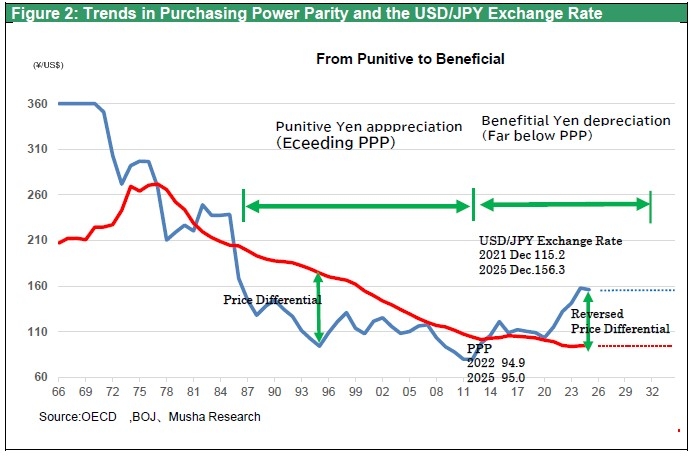
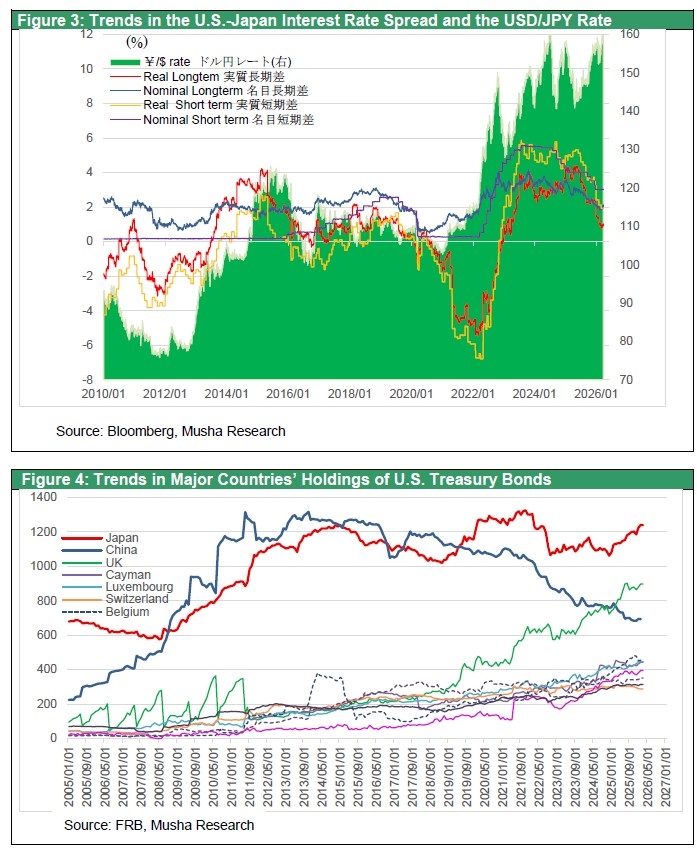
There is no change in the fact that maintaining a strong dollar and a weak yen is in the national interests of both Japan and the United States
However, the long-term trend of a strong dollar remains intact, and U.S. national interests still lie in a strong dollar. This intervention was not intended to push down the dollar-yen exchange rate but was conducted to curb yen weakness beyond the ceiling. A certain degree of yen appreciation—for example, exceeding 145 yen per dollar—undermines the national interests of both Japan and the United States. For Japan, this weakens external competitiveness, curbs domestic investment that has finally begun to pick up and revives deflationary pressures. For the United States, it pushes up import prices, raises U.S. interest rates, and slows the economy. From this perspective, monetary and fiscal policies that do not allow yen appreciation pressures to become too strong are desirable. It could be said that the Takaichi administration’s high-pressure economic policies—which restrain interest rate hikes and provide relief to households strained by the consumption tax cut—have become easier to implement thanks to support from the United States.
*Note: Only the coordinated intervention on March 18, 2011, failed to reverse the trend toward a weaker yen. Even considering the difficulties posed by the natural disaster and the resulting repatriation of overseas assets, the primary responsibility lies with the Bank of Japan. Although Mr. Shirakawa has offered various excuses, he failed to send a strong message that the yen would be devalued through a sufficiently accommodative monetary stance and thus was unable to fend off speculators betting on a strong yen. Due to the sustained yen appreciation over the past two years, Japan has lost many of its crown jewels—its premier industries and companies.
For details on the circumstances at that time, please refer to the following reports:
Key Strategy Issues No. 292 (March 22, 2011), “The Significance of G7 Coordinated Intervention: The End Point of Long-Term Yen Appreciation”
https://www.musha.co.jp/attachment/issues_292_20110323_en.pdf
Strategy Bulletin No. 76 (August 2, 2012) “Assert Currency Sovereignty Through Quantitative Easing”
https://www.musha.co.jp/attachment/bulletin_e_20120802.pdf
Strategy Bulletin No. 77 “What Can Japan Learn from the Collapse of the Semiconductor Industry? —Can the BOJ and the Government Hear the Voice of Industry?”
https://www.musha.co.jp/attachment/bulletin_e_20120903.pdf