Aug 19, 2026
Strategy Bulletin Vol.406
Japan Equities: Fiscal Policy, Geopolitics, and the Next Major Uptrend
- The major bottoms and tops in Japanese equities have historically been determined with remarkable precision by fiscal and monetary policy as well as geopolitical developments. The exceptional performance of Japanese equities today began when the formation of the Takaichi administration became increasingly certain last October. It has been driven by expectations that aggressive fiscal policy would raise Japan’s potential growth rate. Those expectations temporarily faded in late June amid the controversy surrounding the Basic Policy on Economic and Fiscal Management and Reform and growing opposition to a consumption tax cut. However, they have since revived through Prime Minister Takaichi’s initiative, and the feasibility of the Takaichi reforms has increased significantly.
- From 2027 onward, the Japanese economy is likely to enter an era of significantly higher growth. A number of powerful positive factors are accumulating: (1) a reduction in the consumption tax on food beginning next April; (2) a pronounced wealth effect resulting from rapidly rising asset prices; (3) a revival of domestic investment driven by yen depreciation and U.S.-China decoupling; (4) the full-scale launch of the ¥370 trillion long-term policy program extending to 2040; and (5) the AI revolution and a major revival of semiconductor investment in Japan.
- There has been widespread skepticism over the continued depreciation of the yen. Major global financial media outlets such as the Wall Street Journal, Financial Times, and The Economist, as well as many leading overseas economists, have published articles based on speculation that there must be some fundamental flaw in Japan’s public finances. Speculators have taken advantage of this mystery to build short positions in the yen. In our view, the current yen weakness is essentially the result of a self-generated campaign by Japan’s Ministry of Finance. The narrative that “Japan’s fiscal deficit is serious → cutting the consumption tax would constitute a national crisis → the yen will collapse” has been constructed through a coordinated public-private campaign in Japan, with speculative investors piling onto the story.However, Japanese and U.S. authorities could no longer tolerate the yen’s depreciation and moved to coordinated intervention. At this point, Japan’s Ministry of Finance will have no choice but to revise its campaign emphasizing the severity of the fiscal deficit. The U.S. authorities will cooperate through coordinated intervention. Speculators betting on further yen depreciation will have little choice but to retreat. The scenario of “Japanese fiscal collapse → sharp yen depreciation” is likely to disappear without a trace.
(1) A Historic Moment in Which a Political Decision Triggers a New Upswing in Equities
The feasibility of the Takaichi reforms has increased substantially now that the central pillar of the Basic Policy reduction in the consumption tax on food—has been formally approved by the LDP General Council and adopted by the Cabinet. Since late June, uncertainty over the Takaichi administration’s economic policies have generated a simultaneous decline in stock prices, rise in interest rates, and depreciation of the yen, creating heightened uncertainty about the market outlook. Yet this may prove to be an exceptionally attractive investment opportunity.
Every major turning point in the Nikkei since the end of World War II has been determined by financial and fiscal policy and geopolitics. There have been four major episodes to date:
1)The outbreak of the Korean War in June 1950, from a Nikkei level of ¥90;
2)The market peak at the end of December 1989, triggered by monetary tightening aimed at bursting the bubble, from a Nikkei level of ¥38,916;
3)The market bottom in May 2003, following the partial nationalization of Resona Bank and the completion of the disposal of non-performing loans, from a Nikkei level of ¥8,117; and
4)The major bottom on November 14, 2012, when the beginning of the Abe administration and the Abenomics transformation was set in motion by the announcement of the dissolution of the House of Representatives, from a Nikkei level of ¥8,664.
The formation of the Takaichi administration is now creating what could become the fifth major long-term trend reversal of the postwar era (see Figure 2).
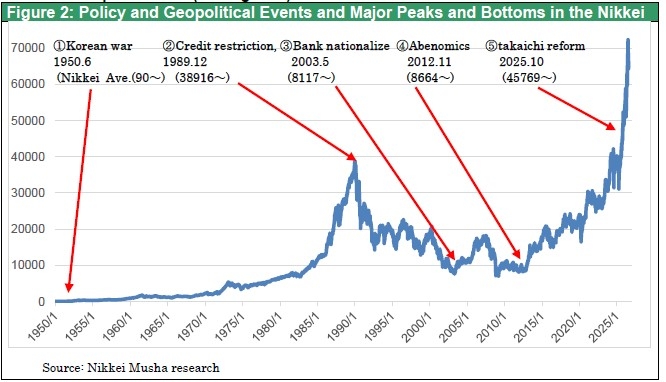
When the establishment of the Abe administration and the implementation of Abenomics became certain in November 2012, the Nikkei rose 80% in six months. Similarly, after Sanae Takaichi became president of the LDP in October 2025, the Nikkei rose 60% over the following eight months. The underlying driver was expectations of higher economic growth resulting from proactive fiscal policy—in other words, expectations of “Sanaenomics.”
Over the past month, concerns intensified that Prime Minister Takaichi’s proactive fiscal policies would be derailed by a campaign against tax cuts led by the Ministry of Finance and major media outlets, and her approval rating declined. However, those concerns have been pushed back by the Prime Minister’s leadership.
(2) Why Proactive Fiscal Policy Has the Wind at Its Back
Proactive fiscal policy will be decisively important for Japanese equities going forward because fiscal stimulus will raise Japan’s potential growth rate and ensure sustained growth in corporate earnings.
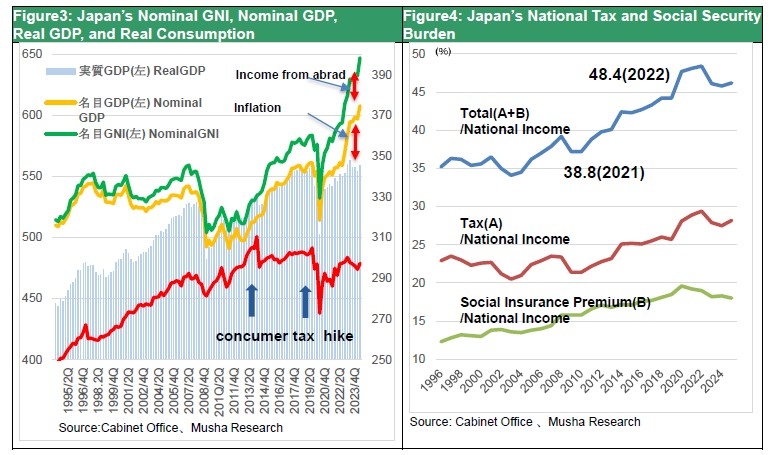
The first reason is that fiscal support for household living standards is urgently needed. Real household consumption stood at ¥302 trillion at the end of fiscal 2012 and ¥311 trillion at the end of fiscal 2013, compared with only ¥300 trillion in 1Q 2026 (2020 prices). It therefore remains below the peak reached more than a decade ago (Figure 3).
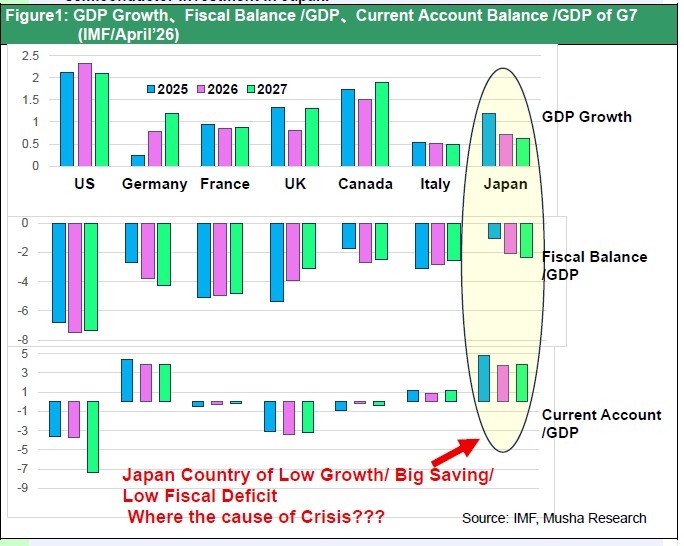
Japan’s economic growth rate also remains among the lowest in the G7. The fundamental reason is that consumption, the largest component of demand, has remained depressed for a decade.
Comparing the IMF’s economic forecasts for 2026 and 2027, the United States is projected to grow 2.3% → 2.1%, the euro area 1.1% → 1.2%, while Japan is expected to grow only 0.7% → 0.6%, leaving Japan substantially behind.
Second, tax revenues have increased substantially, strengthening the government’s fiscal capacity. According to the IMF’s April 2026 Economic Outlook data, Japan stands out among the G7 for the extent to which its fiscal deficit has narrowed despite having the lowest economic growth rate. Japan’s general government fiscal deficit as a percentage of GDP was just 1.67% in 2024 and 1.05% in 2025, making Japan’s deficit the smallest in the G7 for two consecutive years.
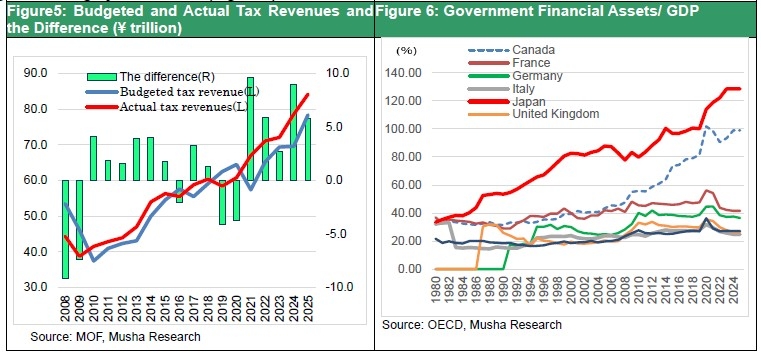
Since 2021, tax revenues have routinely exceeded the initial budget estimate by ¥6–10 trillion. The upside surprise in tax revenues is equivalent to 1.0–1.6% of GDP (Figure 5).In addition, the Japanese government holds a huge stock of financial assets equivalent to approximately 130% of GDP, including unrealized gains of roughly ¥300 trillion (Figure 6).
Third, the public strongly wants fiscal support for household living standards. In the most recent Lower House election, every ruling and opposition party except the newly formed Mirai Party included a consumption tax cut in its campaign platform. Regardless of differences in the specific mechanisms proposed, all political parties, including the Democratic Party for the People, will suffer a major loss of popular support if they fail to embrace the broad consensus in favor of tax cuts.
Why are improving tax revenues and deteriorating household living standards occurring simultaneously?
The answer lies in the “integrated reform of social security and taxation” implemented during the deflationary period. This drove Japan’s national burden ratio sharply higher, from 38.8% in fiscal 2011 to 48.4% in fiscal 2022 and an estimated 46.2% in fiscal 2024 (Figure 4). The integrated social security and tax reform raised social insurance premiums and consumption taxes and created a system designed to ensure that tax revenues would not fall short even under deflation.
But the economy subsequently experienced inflation that was far stronger than anticipated. Tax revenues and corporate profits increased dramatically, while households suffered a severe deterioration in living standards.Since 2014, corporate profits have increased 2.5-fold, stock prices sixfold, and tax revenues twofold. Against this backdrop, it is entirely reasonable to provide tax relief to support consumption, the one major component of the economy that has been left behind.
If such relief is withheld in the name of fiscal consolidation, it will exert a significant downward pressure on domestic demand.
(3) The “Honebuto Shock” Argument Is Entirely Misguided
The opposition to tax cuts was extraordinary. When the draft of the Basic Policy was presented on June 30 and proposed reducing the consumption tax on food to 1%, the yen happened to be weakening while long-term interest rates were rising. The Ministry of Finance, economists, and major media outlets immediately developed a narrative that the Basic Policy and the proposed consumption tax cut had triggered concerns about fiscal deficits and a sell-off of Japan, calling the episode the “Honebuto shock.”
The argument was that tax cuts would trigger selling of Japanese assets and produce the side effect of stagflation—higher inflation combined with slower growth—and therefore should be abandoned.
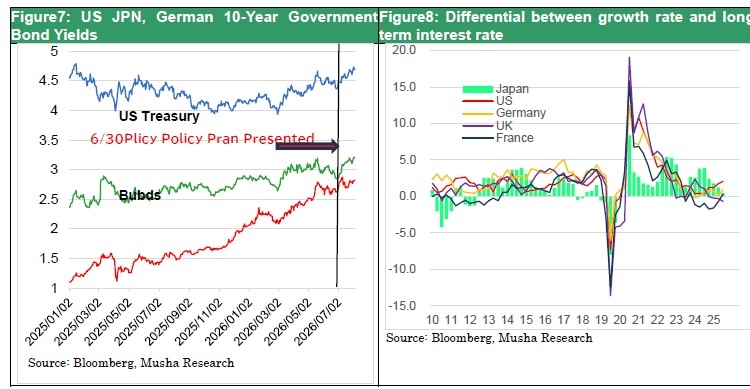
But the “Honebuto shock” argument is completely misplaced. First, both the rise in interest rates and the depreciation of the yen were largely synchronized with global increases in interest rates and the strengthening of the U.S. dollar; they were not uniquely Japanese developments. Indeed, although global long-term interest rates began rising more sharply from late July onward, Japan’s long-term rates were moving in the opposite direction and declining (Figure 7).
Moreover, with nominal economic growth exceeding 4%, a long-term interest rate of just under 3% is by no means problematic for Japan. Japan’s nominal growth rate exceeds its long-term interest rate by wider margin among the G7 economies (Figure 8).The data therefore makes it abundantly clear that there is little factual basis for criticism of proactive fiscal policy.
The yen, however, continued to weaken until coordinated Japanese-U.S. foreign-exchange intervention was carried out on July 30.
The Ministry of Finance’s campaign portraying Japan’s public finances as being in worse condition than Greece’s was simply too successful. It obscured the fact that Japan’s fiscal position is sound and provided speculators with a pretext to sell Japan.
Seeing the yen’s weakness and unable to identify any other obvious explanation, major global financial media outlets such as the Wall Street Journal, Financial Times, and The Economist, as well as leading economists, began speculating that Japan must have a serious fiscal problem and published editorials and columns accordingly. For example, Julian Ted, one of the journalists regarded as particularly knowledgeable about Japan, wrote in an FT column—also reproduced in the Nikkei—titled “All Eyes on the Yen as Japan’s First Debt Crisis Comes into View”:
“The biggest factor behind the yen’s weakness is the huge public debt. ... Following recent rate hikes, debt-servicing costs in the fiscal 2026 budget have already reached ¥31 trillion, accounting for one-quarter of total government spending. The Ministry of Finance estimates that this will rise to one-third of spending by fiscal 2029. This is a frightening prospect.” (August 14)
This is a fundamentally misguided argument. The ¥31.3 trillion in debt-servicing costs in the fiscal 2026 budget consists of ¥18.2 trillion in principal redemptions and ¥13.0 trillion in interest payments. Half of the interest payments are made to the Bank of Japan and subsequently returned to the government as payments to the government by the BOJ. Accordingly, the genuine fiscal cost is only about ¥7 trillion, equivalent to just 6% of the ¥122 trillion total budget. Ted fails to recognize that two-thirds of the debt-servicing figure consists of principal repayments that do not represent an economic cost in the conventional sense.
This is precisely the kind of mechanism that George Soros—under whom U.S. Treasury Secretary Scott Bessent once served—described in his theory of reflexivity (Note): market psychology can generate a self-reinforcing vicious cycle. Even if the argument that yen depreciation is caused by Japan’s fiscal deficit is factually incorrect, if it continues to be widely accepted internationally, a further depreciation of the yen could potentially push the economy into crisis.
If the Ministry of Finance’s propaganda is creating the very conditions for selling Japan, this is an argument that seriously damages the national interest. The Ministry of Finance should substantially revise the fiscal-crisis narrative about Japan that it has promoted and exaggerated to date under the Takaichi administration—and, ultimately, it will have little choice but to do so.
(Note) Reflexivity is the theory that people’s perceptions and actions change reality, and that the changed reality in turn changes people’s perceptions and actions. Normally, the dog (economic fundamentals) wags the tail (market prices such as stock prices), but at times the tail (market prices) can change the dog (economic fundamentals). This feedback mechanism can produce self-fulfilling financial crises.
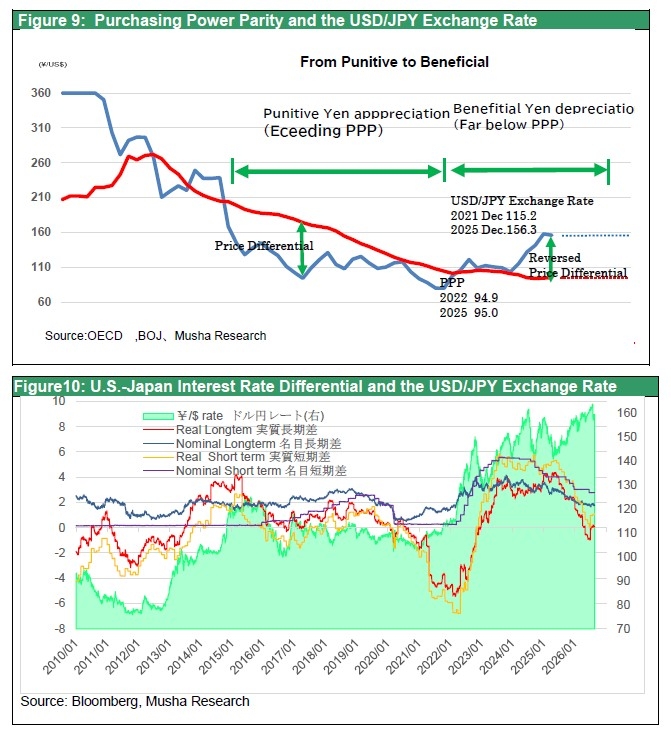
On July 30, Japan and the United States conducted coordinated foreign-exchange intervention for the first time in 15 years, signaling that a USD/JPY level around 160 represents the upper limit that the governments of Japan and the United States are prepared to tolerate. President Trump stated, “We will always support Japan. This is a sign of friendship.” The intervention will be successful, and there is a strong possibility that a ceiling has now been established around the recent highs in USD/JPY.
There are three reasons. First, further yen depreciation would damage the national interests of both Japan and the United States. Second, further yen depreciation would be inconsistent with economic fundamentals, including purchasing power parity and the interest-rate differential (Figures 9 and 10). Third, Japan’s Ministry of Finance will be forced to correct the completely erroneous perception that Japan faces a severe fiscal crisis. Speculators will ultimately retreat in the face of the authorities’ determination.
(4) Proactive Fiscal Policy and the Wealth Effect Will Raise Japan’s Potential Growth Rate—Putting 100,000 on the Nikkei in Sight Next Year
As concerns over further yen depreciation fade, pressure on the Bank of Japan to raise interest rates will also ease. With crude oil prices having peaked and the yen’s depreciation stabilizing, cost-push inflation should subside. Inflationary pressure stemming from rising wages will remain, but that is actually a desirable development. Once speculators understand that Japan’s public finances are sound and that the Japanese government has effectively unlimited resources for foreign-exchange intervention, there is even a risk that speculation will shift toward yen appreciation. Indeed, if the yen appreciates too rapidly, the BOJ may become reluctant to raise interest rates further.
The United States’ firm stance on foreign-exchange intervention is likely to support the Takaichi administration. It should help suppress criticism of the “Honebuto shock” and make it easier for the government to pursue proactive economic policies.
From 2027 onward, the Japanese economy is likely to enter an era of significantly higher growth.
The positive factors are numerous:
- A reduction in the consumption tax on food beginning next April;
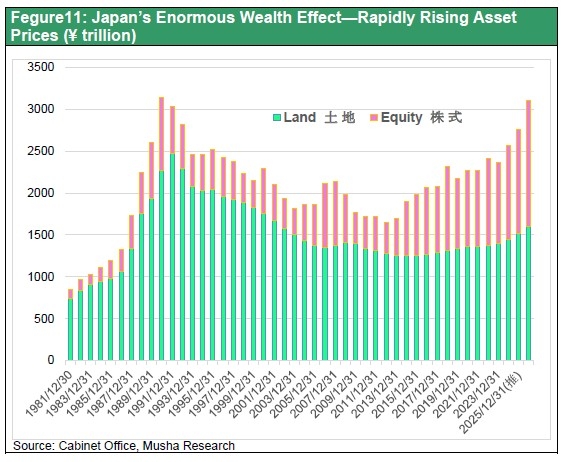
- A pronounced wealth effect resulting from rapidly rising asset prices (Figure 11);
- A revival of domestic investment driven by yen depreciation and U.S.-China decoupling;
- The full-scale launch of the ¥370 trillion long-term policy program extending to 2040; and
- The AI revolution and a major revival of semiconductor investment in Japan.
The rise in asset prices was the principal engine of the U.S. economic recovery after 2009. Japan is now experiencing a wealth effect equivalent to roughly twice the size of GDP. With interest rates and the exchange rate stabilizing, stock prices should regain their upward momentum.
The Nikkei 225 could potentially reach ¥100,000 during 2027.