Sep 07, 2026
Strategy Bulletin Vol.407
The Mystery of Rising Japanese Interest Rates and Bessent’s Remarks
— Confirming the Peaks in Japanese Interest Rates and USD/JPY, Paving the Way for a Stock Market Sur
(1) The Mystery of Rising Japanese Interest Rates
The rise in Japanese interest rates is mysterious. U.S. Treasury Secretary Scott Bessent is concerned that it could spill over into the United States. If the rise in rates is due to concerns over Japan’s fiscal position or accelerating inflation, he would presumably like to see it brought to an end. At the same time, a weaker yen fuels inflation in Japan. If left unchecked, this could trigger a vicious cycle of yen depreciation → accelerating inflation → rate hikes. Since such a development would run counter to U.S. national interests, the logic behind coordinated intervention is straightforward.
Normalization of Interest Rates Alone Amid Economic Stagnation
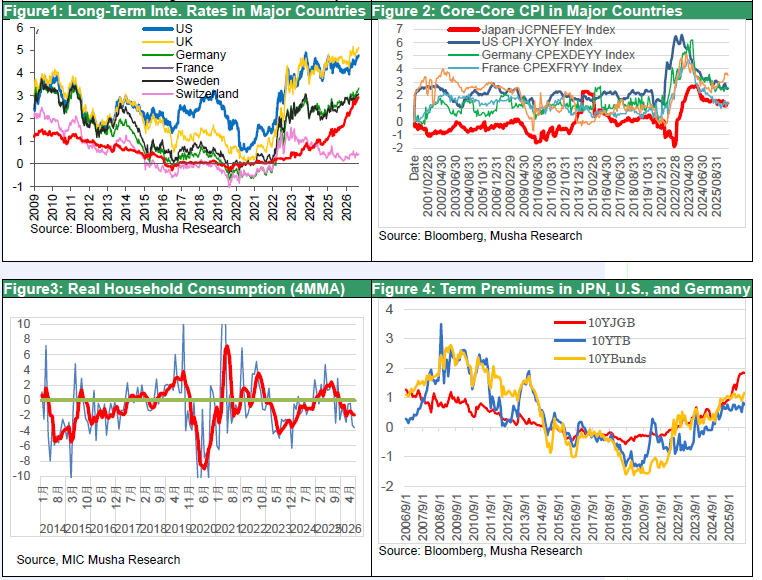
At the root of the issue lies the mystery of the sharp rise in Japanese interest rates. Japan’s 10-year government bond yield broke above 3% on September 1 for the first time in 30 years. As shown in Figure 1, this is roughly in line with levels in European countries such as Germany and Sweden, where healthy inflation has continued. In just three years since the zero-interest-rate policy was lifted at the end of 2022, Japan has undergone a rapid process of “normalization,” reaching interest-rate levels comparable to those of other countries.
Figure 1: Trends in Long-Term Interest Rates in Major Countries
Figure 2: Trends in Core-Core CPI Inflation Rates in Major Countries
Figure 3: Year-on-Year Changes in Japan’s Real Household Consumption (4MMA)
Figure 4: Trends in 10-Year Government Bond
Japan Faces Concerns Over an Economic Slowdown, While Core-Core CPI Remains Well Below the 2% Target
If we ask whether this rise in interest rates is justified by an improvement in Japan’s economic fundamentals, the answer is clearly no. Japan’s GDP growth rate is particularly low even within the G7 (Figure 5), while real household consumption in July fell 3.6% year on year, marking the eighth consecutive month of decline (Figure 3). The prolonged weakness in consumption, which peaked in the first quarter of 2014, has by no means been resolved.
Moreover, when underlying inflationary pressure is compared using the core-core CPI—the most important measure, excluding food and energy—it is clear that Japan’s inflationary pressure is significantly weaker than that of other countries (Figure 2). There is simply no evidence that Japan’s potential growth rate has risen to levels comparable with those of other advanced economies.
Japan’s Exceptionally High Government Bond Term Premium
What, then, explains the rise in long-term interest rates despite the divergence from economic fundamentals? No one, including Mr. Bessent, knows the definitive answer.
What is clear, however, is that Japanese government bonds are carrying a substantial risk premium. A 10-year government bond yield can be decomposed into two components: 1) the accumulation of short-term interest rates implied by the yields on shorter-maturity government bonds, and 2) the risk premium that accrues over the period until maturity (i.e., the term premium).
Figure 4 shows the evolution of the term premiums on 10-year government bonds in the U.S., Germany, and Japan. It clearly demonstrates that the term premium on Japanese government bonds has risen exceptionally sharply. Since 2025, the U.S. and Germany have remained in a range of roughly 0.6% to 1.0%, whereas Japan’s term premium has reached 1.8%.
If risk has suddenly increased only in Japanese government bonds, why is that? Given that Japan’s core-core CPI, excluding food and energy, is more subdued than in other countries, it is clear that inflation is not the explanation.
If so, the only plausible explanation would appear to be fiscal concerns stemming from the Takaichi administration’s expansionary fiscal policy. This is perhaps the prevailing view among global investors. Many media reports have emphasized that the Takaichi administration’s draft of its “Basic Policy” featuring “responsible expansionary fiscal policy,” presented at the end of June, caused a shock in the bond market. Such reporting has further reinforced this perception.
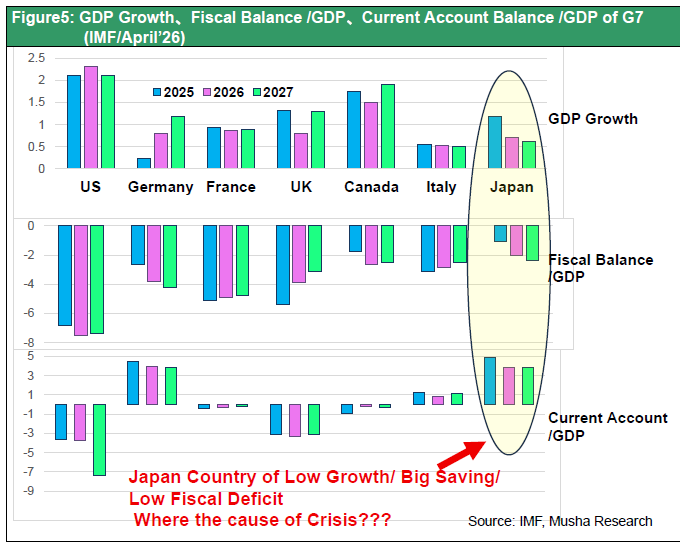
Figure 5: G7 Growth Rates, Fiscal Balances, and Current Account Balances—Actuals and Forecasts (IMF, April)
Japan’s Fiscal Position Is Sound and Its Savings Are Abundant
This view, however, is clearly mistaken.In Japan, tax revenues have increased substantially, strengthening the government’s fiscal capacity. Comparing general government fiscal balances as a percentage of GDP across the G7, based on the IMF’s April 2026 World Economic Outlook database, the reduction in Japan’s fiscal deficit stands out despite the country’s exceptionally low economic growth rate.
Japan’s fiscal deficit as a percentage of GDP was 1.67% in 2024 and 1.05% in 2025, making Japan’s deficit the smallest in the G7 for two consecutive years. Since 2021, tax revenues have routinely exceeded the initial budget projections by ¥6–10 trillion. In fiscal 2025, final tax revenues amounted to ¥84.2 trillion versus an initial budget estimate of ¥78.4 trillion, an excess of ¥5.8 trillion. The amount by which tax revenues have exceeded budget projections is equivalent to 1.0–1.6% of GDP (Figure 6).
A reduction in the consumption tax on food is estimated to cost ¥5 trillion annually, but this could be covered by the excess in tax revenues. In addition, approximately ¥27 trillion in dollar-selling foreign-exchange intervention was carried out in total during April–May and July–August. The realized foreign-exchange gains from these interventions are estimated at ¥7–10 trillion, which would also constitute non-tax revenue.
Given such ample fiscal resources, it is difficult to see why the term premium should rise. In the first place, as Figure 7 shows, the Japanese government holds an exceptionally large amount of financial assets compared with other countries—equivalent to approximately 120% of GDP—and the income generated from these assets is substantial.
Above all, it should be remembered that the exceptional rise in Japan’s term premium began before the Takaichi administration came into existence.
Figure 6: Budgeted vs. Final Tax Revenues and the Difference (¥ Trillion)
Figure 7: Trends in Government Financial Assets as a Percentage of GDP
Is the Rise in the Term Premium a Question of Supply and Demand?
What, then, caused Japanese government bonds to be sold so heavily, driving interest rates higher? The answer is likely to be deterioration in the supply-demand balance for government bonds.
The Bank of Japan began quantitative tightening (QT)—the unwinding of quantitative monetary easing—in February 2024. Since then, it has reduced its holdings of Japanese government bonds from a peak of ¥588 trillion to ¥497 trillion as of the end of June 2026. This represented net sales of ¥50 trillion in government bonds over the past year.
This rapid tapering appears to have significantly worsened the supply-demand balance. In the United States as well, the Federal Reserve reduced its holdings of U.S. Treasuries dramatically, from $6 trillion to $4 trillion through QT. However, the resulting rise in interest rates triggered a sharp increase in domestic investment in Treasuries through money market funds, more than offsetting the reduction in Fed holdings.
In Japan, by contrast, the ¥1,200 trillion in household cash and deposits has hardly flowed into government bonds.
Figure 8: U.S. Treasury Holdings by Investor Category
Figure 9: GPIF Asset Allocation and the Composition of Its ¥1/4 Quadrillion(?) in Assets Under Management
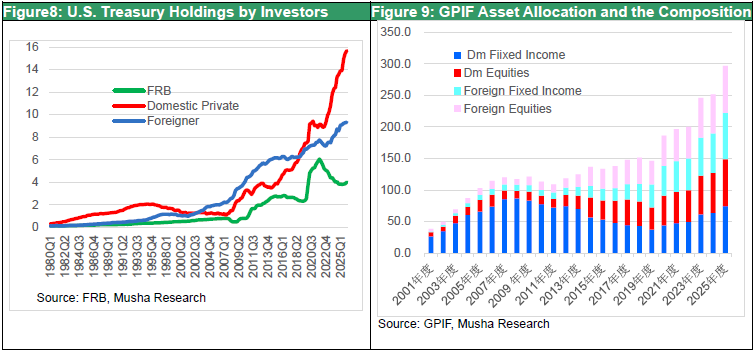
The Government Pension Investment Fund (GPIF), once the world’s largest institutional investor and the largest investor in Japanese government bonds, changed its investment framework in its 2014 reform to hold domestic bonds, foreign bonds, domestic equities, and foreign equities in equal proportions of one-quarter each.
As a result, GPIF continued selling Japanese government bonds and realized enormous investment gains. The Bank of Japan absorbed this selling pressure through its massive purchases of Japanese government bonds.
Yet there is no question that this asset allocation is extremely risky. Pension payment obligations are 100% yen-denominated, while half of the assets backing those obligations are foreign assets. Until now, GPIF has fortunately benefited from the depreciation of the yen. But if Japan succeeds in its economic reforms and its growth rate rises, the yen will inevitably appreciate.
In the United States and virtually every other country, the principal investors responsible for pension management invest primarily in their own government’s bonds. Eventually, GPIF is likely to reduce its foreign-currency assets and shift its portfolio toward Japanese government bonds.
A change in GPIF’s investment policy would also spread to other pension and insurance asset managers. This would generate enormous buying pressure for Japanese government bonds and selling pressure on the dollar.
(2) Outlook for Interest Rates, Foreign Exchange, and Stock Prices
Long-Term Interest Rates in Japan and the U.S. Are Near Their Peaks
In both Japan and the U.S., the biggest factor behind the rise in interest rates is monetary policy. However, in both countries, we expect downward pressure on rates to intensify over the next six months.
There are three reasons:
- Core-core CPI is clearly on a downward trend (Figure 2).
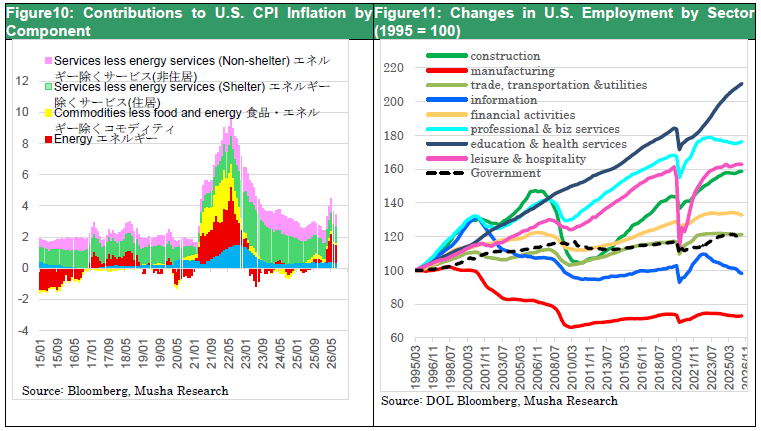
- The current rise in prices is primarily attributable to energy prices stemming from the Strait of Hormuz, and this effect will disappear from April next year onward because CPI is measured on a year-on-year basis (see Figure 10).
- Employment-reduction pressures from the AI revolution are intensifying, and the focus of policy will shift from inflation toward employment.
As shown in Figure 11, in the United States, employment declines are becoming pronounced not only in manufacturing but also in the information industry and in high-income professional services such as consulting and law.
Although sentiment toward further rate hikes is strengthening, at most we expect only one more rate hike in both the U.S. and Japan.
In Japan, some members of the policy board and media commentators have been arguing for rate hikes based on nebulous discussions of the neutral interest rate and the notion that real interest rates are negative. However, when real interest rates are calculated using core-core CPI, Japan actually has the highest real interest rate among the major economies.
If quarterly rate hikes, which are being discussed with increasing confidence in the market, were to become reality, we should remember that this could bring about a repeat of the 2025 Ueda shock.
If rate hikes are forced through, yield curves would flatten in both Japan and the United States. In any event, long-term interest rates can now be considered to be in the vicinity of their peaks.
Figure 10: Contributions to U.S. CPI Inflation by Component
Figure 11: Changes in U.S. Employment by Sector (1995 = 100)
There Are Few Factors Left to Drive Further Dollar Weakness Against the Yen
As we have explained for some time, there are few remaining factors that would drive further dollar depreciation against the yen.
In addition to three clear fundamental factors—1) the rapidly narrowing Japan-U.S. interest-rate differential, 2) the yen’s extreme undervaluation relative to purchasing power parity, and 3) Japan’s abundant excess savings—there is also the clear, coordinated intention of the Japanese and U.S. authorities.
The Greater Risk May Actually Be an Unexpected Surge in the Yen
The greatest risk associated with a Bank of Japan rate hike is that it could trigger a sharp appreciation of the yen, thereby cooling domestic investment just as it is beginning to recover.
This must be avoided at all costs.
If a BOJ rate hike is avoided and a reduction in the consumption tax and the Basic Policy begin to take effect, Japan’s potential growth rate could rise, making it highly likely that the surge in Japanese equities that began with the launch of “Sanaenomics” will continue.
The positive factors are piling up:
- A reduction in the consumption tax on food beginning next April.
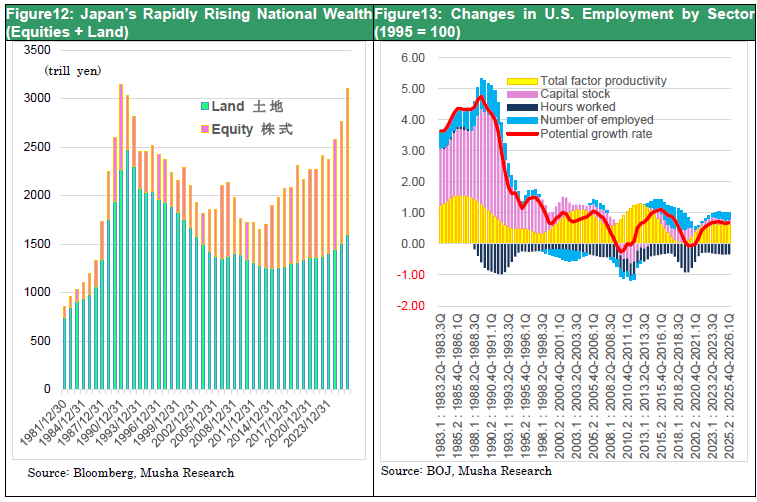
- A pronounced wealth effect from rapidly rising asset prices: 3,140 → 1,640 → 3,100. This suggests an effect equivalent to two to three times GDP.
- A revival of domestic investment in Japan driven by the weaker yen and U.S.-China decoupling.
- The full-scale launch of the ¥370 trillion “Basic Policy” toward 2040.
- The AI revolution and a major revival of semiconductor investment in Japan, among other favorable factors.
Expansionary fiscal policy will be critically important for Japanese stock prices going forward. Fiscal stimulus will raise Japan’s potential growth rate and thereby ensure sustained growth in corporate earnings.
The key to raising the potential growth rate is to substantially lower the cost of capital through both fiscal and monetary policy, thereby rebuilding the investment-led virtuous cycle that has been lost for so long.
The mission of the Ministry of Finance and the Bank of Japan is to promote this process. Under no circumstances should they stand in its way.
Figure 12: Japan’s Rapidly Rising National Wealth (Equities + Land)
Figure 13: Capital Input as the Decisive Factor Depressing Japan’s Potential Growth Rate