Sep 16, 2026
Strategy Bulletin Vol.408
The Historic Mission of the Second Takaichi Administration
— Economic and Market Outlook under Takaichi’s Conservative Revolution —
Humanity is now entering an unprecedented period of transformation: the AI revolution. For roughly 10,000 years, human beings lived by gathering natural resources much like other animals. Then, with the advent of food cultivation and settled societies, the creation of wealth began to accelerate dramatically. This was the Agricultural Revolution, after which land became the ultimate source of value. Civilizations emerged, and incessant conflicts over land began.
The Industrial Revolution 300 years ago ushered in the capitalist era, in which wealth was created through the deployment of capital and labor, while the importance of land declined substantially. Today, humanity is entering the age of the AI revolution, in which enormous wealth will be generated not by land, capital, or labor, but by AI. The contours of the social and institutional order that will emerge remain completely unclear. What is certain, however, is that the enormous power of AI will open the way to a new era.
A serious systemic confrontation is unfolding over whether this enormous power will ultimately be controlled by “autocrats” or by “democracy and market economies.” The fact that China’s challenge to U.S. global hegemony has coincided with the dawn of the AI era has made it increasingly difficult to reconcile the competing interests. Humanity may be entering a new historical phase resembling a world war—a potential Third World War. The actions of the Trump administration, which may appear erratic at first glance, as well as the conflicts in Ukraine and Gaza and the wars involving Venezuela and Iran, may be understood only in this broader context.
The Second Takaichi Administration bears the historic responsibility of determining where Japan should be headed during such a period of transformation. Following the overwhelming mandate given to Ms. Takaichi by voters in the House of Representatives general election on February 8, the direction desired by the Japanese public appears to have been largely determined. What exactly is that direction? The following is an overview.
(1) The Emergence of Inequality in Japan: A Striking Contrast between the Declining Middle Class and Surging Corporate Profits
Until early last year, it was widely believed that Japan would not experience a Trump phenomenon similar to that of the United States. However, in the 2025 House of Councillors election, support for parties such as the Democratic Party for the People (DPP), Sanseito, and the Conservative Party of Japan expanded, particularly among the working-age population, while the established parties suffered significant losses in support. Behind this phenomenon is the existence of a “declining middle class,” a phenomenon Japan shares with the United States.
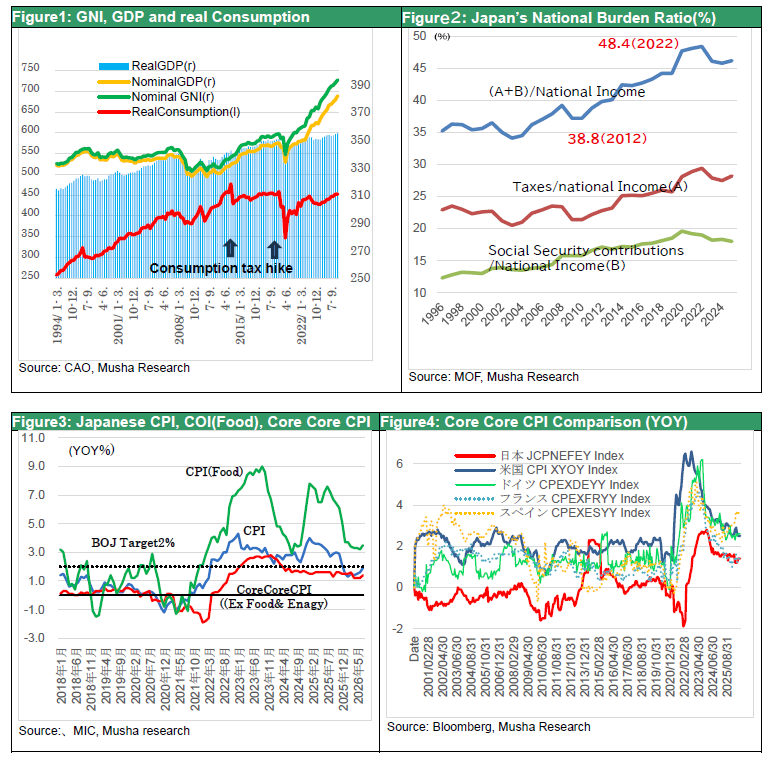
Japan’s GDP has continued to expand in both nominal and real terms, but real consumption has remained stagnant since peaking in 2014. The underlying factors have been increases in the consumption tax and social insurance contributions. Following the 2012 “Integrated Reform of Social Security and Taxation,” the consumption tax rate was raised twice, in 2014 and 2019, while successive increases in social insurance contributions drove up the overall tax and social security burden on households. Japan’s national burden ratio rose sharply from 38.8% in 2012 to 48.3% in 2022—an increase of 10 percentage points despite the lack of meaningful growth in wages—thereby reducing households’ disposable income.
The Japanese standard of living, as measured by real private consumption, continued to rise after the bursting of the bubble in 1990 until the consumption tax increase in 2014. It was the consumption tax increases in 2014 and 2019 that dealt a decisive blow to household living standards (see Figure 1 and 2).
In addition, the rise in crude oil prices following the war in Ukraine and import inflation caused by the weaker yen eroded household purchasing power. These forms of inflation were largely exogenous inflation, rather than the wage inflation Japan needs and should welcome—namely, wage increases exceeding productivity growth that raise workers’ real incomes (see Figure 3 and 4).
As a result, real household consumption has still not recovered, even in 2026, to its peak level of the first quarter of 2014. This has fueled political dissatisfaction among the working-age population and contributed to the rise of emerging conservative parties. Within the Liberal Democratic Party (LDP), it also helped propel Ms. Takaichi to the party leadership, transforming the government from the LDP-Komeito centrist coalition to a conservative LDP-Ishin coalition, and ultimately lead to the overwhelming mandate for Ms. Takaichi in the House of Representatives election.
Thus, Japan’s political transformation should not be understood merely as a matter of political fashion. It should instead be understood as a phenomenon arising from changes in the economic structure and in the public’s perception of its own living standards.
Figure 1: Trends in Japan’s Real Consumption, GDP, and GNI
Figure 2: Trends in Japan’s National Burden Ratio
Figure 3: Trends in Japan’s CPI by Component
Figure 4: Trends in Core-Core CPI Inflation in Major Economies
In stark contrast to the stagnation in household consumption, corporate profitability has improved dramatically.
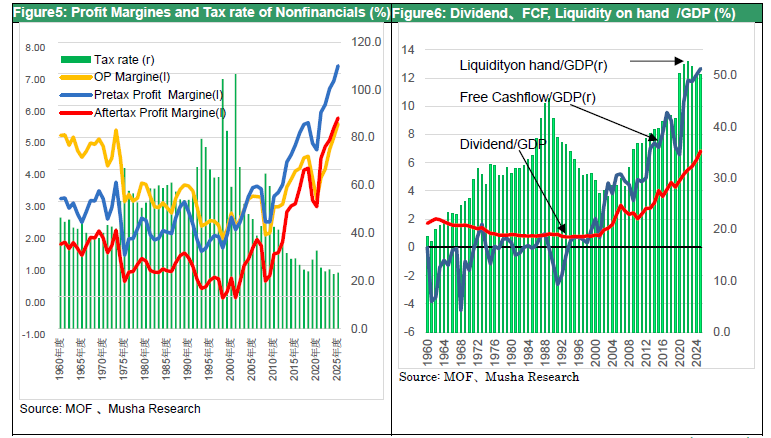
First, corporate earning power has increased dramatically. Looking at the trends in the Financial Statements Statistics for Corporations by Industry, operating profit margins have changed relatively little, but ordinary profit margins have improved substantially, reflecting contributions from overseas earnings and financial income. Moreover, net profit margins have risen sharply because of a significant decline in effective tax rates (Figure 5).
The after-tax profit margin on corporate sales surged from below 1% in 2010 to 5.6% at the end of FY2025. This dramatic improvement in corporate value-creation capacity was a major result of Abenomics and the Bank of Japan’s unprecedented monetary easing.
Second, corporate financial surpluses have increased substantially. Corporate free cash flow relative to GDP—defined as net income plus depreciation minus capital expenditure—was approximately zero or negative through 2000 but subsequently rose sharply to 12.7% in 2025. Corporate liquidity holdings—cash and short-term securities—increased from ¥160 trillion in 2000, or approximately 30% of GDP, to ¥338 trillion in 2025, or 50% of GDP (see Chart 6).
Third, corporate payouts to shareholders have increased substantially. Dividends as a percentage of nominal GDP, according to the Financial Statements Statistics of Corporations by Industry, surged from 0.9% in 2000 to 6.8% in 2025. Share buybacks have also increased sharply. Corporate purchases of shares amounted to ¥12.6 trillion in 2022, ¥14.3 trillion in 2023, ¥21.6 trillion in 2024, ¥25.1 trillion in 2025, and ¥22.0 trillion during January–August 2026, representing a 32% increase from the same period of the previous year.
Fourth, Japanese corporations are experiencing a boom in global investment. The outstanding stock of Japan’s outward foreign direct investment increased dramatically, from ¥18 trillion in 2000 and ¥51 trillion in 2010 to ¥286 trillion at the end of 2025. The annual increases during this period were ¥20 trillion in 2021, ¥22 trillion in 2022, ¥31 trillion in 2023, ¥16 trillion in 2024, and ¥36 trillion in 2025.
These figures suggest that, supported by abundant financial surpluses, Japanese corporations have entered an era of substantial shareholder returns and large-scale global investment.
Figure 5: Corporate Profit Margins and Effective Tax Rates (%)
Figure 6: Corporate Free Cash Flow, Dividends, and Liquidity / GDP (%)
(2) Fiscal Policy and the Distortion of National Income Distribution
As described above, household consumption remained weak, first because of higher taxes and a heavier overall burden and subsequently because of declining real incomes caused by inflation. Meanwhile, wealth became concentrated in the government and corporate sectors, undermining the healthy circulation of the economy. In retrospect, it is noteworthy that macroeconomic policy was poorly aligned with economic trends, while distortions in resource allocation continued to deepen.
The first major cause was the “Integrated Reform of Social Security and Taxation” decided in 2012. The reform was based on two assumptions: the pessimistic view that “Japan cannot be expected to grow because of its declining birthrate and aging population,” and the austerity-oriented view that “Japan’s fiscal situation is in crisis.” On this basis, a high overall burden was adopted.A broadly shared argument among the ruling and opposition parties, the media, academics, and economists were that “a high burden is necessary to maintain social security, including pensions, healthcare, and nursing care, amid economic maturation, low growth, and an aging population.” As a result, the burden on households rapidly increased.
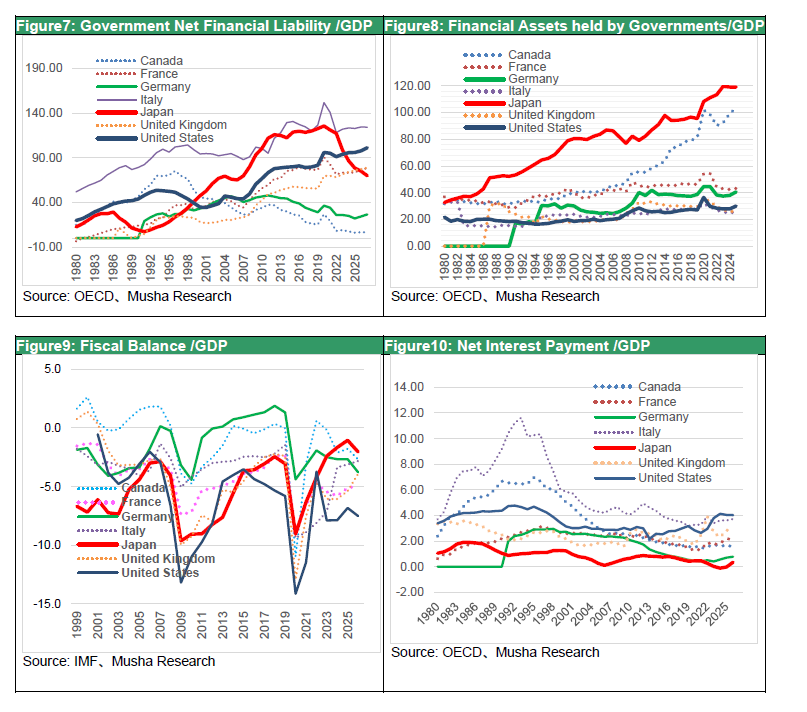
However, the assumption that Japan could not grow was incorrect. Since 2021, Japan has emerged from deflation and entered an era in which nominal economic growth has reached approximately 4%. This has resulted in a substantial increase in tax revenues.The argument that Japan faces a fiscal crisis has also lost much of its credibility. The Ministry of Finance emphasizes that Japan’s gross general government debt stands at 198% of GDP (2025 OECD data), the highest level in the world. However, the Japanese government also owns financial assets equivalent to 119% of GDP (2025), including securities investments by the Government Pension Investment Fund (GPIF), U.S. Treasury securities held through the Foreign Exchange Special Account, and loans and investments in government-related institutions. Excluding these financial assets, the government’s net debt amounts to 78% of GDP, lower than that of the United States, Italy, and France.
On a flow basis, Japan’s fiscal deficit was 1.05% of GDP in 2025 (IMF), the smallest among the G7 economies. Furthermore, Japan’s net government interest burden is exceptionally low by international standards, amounting to a surplus equivalent to 0.02% of GDP in 2025.There are two reasons for this. First, Japan has enormous domestic savings, with households and corporations holding substantial amounts of cash and deposits. This keeps funding costs relatively low and, consequently, limits the interest burden on Japanese government bonds. Second, the Japanese government receives substantial interest and dividend income from its financial assets equivalent to 119% of GDP.
In assessing fiscal soundness and sustainability, the ratio of net government interest payments to GDP is one of the most closely watched indicators internationally. From this perspective, Japan’s fiscal position can instead be regarded as relatively sound.
Furthermore, Japan possesses substantial implicit assets, including foreign-currency assets, primarily U.S. Treasury securities, shares held by the Bank of Japan, and investment gains generated by the GPIF. The Ministry of Finance and public opinion in Japan appear, in the author’s view, to be dominated by an extraordinarily erroneous perception that Japan’s fiscal situation is in crisis.
Separately from the “Integrated Reform of Social Security and Taxation,” fiscal policies favoring corporations to restore the competitiveness of weakened Japanese companies were also extremely extensive. Through the 2014 corporate tax cut, tax incentives under the Act on Special Measures Concerning Taxation, preferential treatment through consumption-tax refunds on exports, and the exclusion of dividends received from overseas subsidiaries from taxable income, the effective corporate tax rate—which had reached 50–60% during Japan’s high-growth period—fell sharply to 23% in FY2025 (see Figure 6).
While labor income has stagnated for households, household income from assets has increased substantially through corporate shareholder returns in the form of dividends and share buybacks, as well as rising stock prices. The resulting widening of inequality is also an issue that warrants attention.
Figure 7: Government Net Financial Debt / GDP in the G7
Figure 8: Government held Financial Assets / GDP in the G7
Figure9:Fiscal Balance /GDP
Figure 10: Governments Net Interest Payments / GDP in the G7
(3) Two Urgent Economic Policies for Japan
This analysis highlights two economic policies that are urgently needed in Japan.
The first is to restore household consumption, which has been severely weakened. The consumption-tax reduction currently at the center of national debate is a key component of this effort.Critics argue that a consumption-tax cut would disproportionately benefit higher-income households and that, because the tax reduction would not necessarily translate fully into lower retail prices, it would not contribute to containing inflation. However, these arguments miss the central point.
The rise in prices that is putting pressure on household living standards is primarily the result of higher crude oil prices stemming from the closure of the Strait of Hormuz and higher import prices caused by the weaker yen, which in turn is pushing up food prices.Looking at the core-core CPI—which excludes food and energy and for which wage growth is a major driver of price changes—it stood at 1.2% in June and 1.4% in July, substantially below the Bank of Japan’s 2% inflation target (Figure 3). Japan’s core-core CPI inflation rate is also low compared with other countries (Figure4).
Meanwhile, Japan’s food-price inflation was exceptionally high at 3.5% year-on-year in July 2026. A consumption tax reduction limited to food would therefore be a targeted policy that directly benefits working-age households under financial pressure.
The second urgent policy is strategic investment in areas essential to the nation’s future. Japan needs to strengthen its supply capacity and competitiveness by expanding investment in defense, research and development, industrial policy, infrastructure resilience, and other strategic areas.
This requires more than simply providing support to corporations. Mechanisms are needed to channel corporate earnings back into households and the domestic economy through wages, dividends, investment, and other channels. At the same time, the government can use fiscal resources for strategic investment, thereby inducing private-sector investment and raising productivity across the economy.
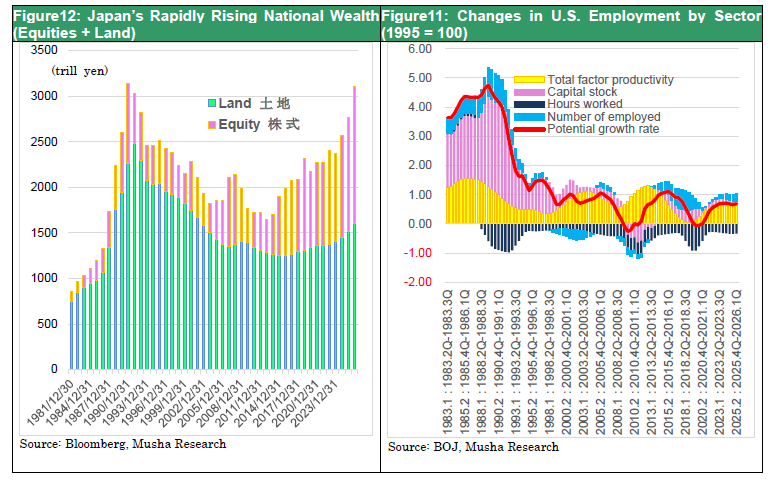
Japan’s long-term economic decline can be inferred from the pronounced decline in its potential growth rate. According to estimates by the Bank of Japan shown in Chart 12, the potential growth rate was around 4% through the 1990s, fell to approximately 1% in the 2000s, and has recently declined to around 0.6–0.7%, among the lowest levels in the developed world.Looking at the contributing factors, the sharp decline in capital input is the largest factor, with reductions in working hours also contributing. The following contractionary cycle has continued to erode Japan’s economic vitality:
Insufficient capital input → insufficient investment → declining supply capacity and slower productivity growth → declining growth potential
This makes the Takaichi administration’s policy objective of ¥370 trillion in cumulative investment particularly significant.
Expansionary fiscal policy is critically important for the future performance of Japanese equities. Fiscal stimulus can raise Japan’s potential growth rate and support sustained growth in corporate earnings.The key to raising potential growth is to substantially lower the cost of capital through both fiscal and monetary policy and rebuild the investment-led virtuous cycle that has been absent for so long. The respective roles of the Ministry of Finance and the Bank of Japan in promoting this process should be clearly defined.
Figure 11: The Decline in Capital Input That Has Severely Depressed Japan’s Potential Growth Rate
Figure 12: Japan’s Rapidly Rising National Wealth (Stocks + Land)
(4) A “New Nationalism” Needed by Japan = A Conservative Revolution
We would like to address the question of what national objectives Japan should pursue in the years ahead. One reason Japan fell into its “Lost 30 Years,” in our view, was not simply the failure of economic policy but also the loss of a unifying national purpose.
During the Meiji era, Japan had national objectives such as “enrich the country, strengthen the military” (Fukoku Kyohei), and strengthening national power became a shared objective throughout society.After Japan’s defeat in World War II, however, a strong tendency emerged to view nationalism itself negatively. As a result, more narrowly defined policy objectives—such as economic growth, fiscal consolidation, and social security—came to replace a broader national purpose.
Without such a big purpose, however, it is difficult to unite the nation around a common direction.What is therefore required is a “new nationalism.” This does not mean a return to militaristic nationalism. Rather, it means rebuilding a national determination to secure Japan’s future through its own capabilities in areas such as national security, the economy, technology, education, and industrial competitiveness.
The rise of China and the war in Ukraine have undermined the assumptions that “as long as the economy develops, national security will be assured” and that “if we desire peace, war can be avoided.” National security and economic policy can no longer be treated separately.Under these circumstances, it is essential not only to strengthen defense capabilities but also to maintain and enhance Japan’s national supply capacity through investment in semiconductors, AI, energy, space, research and development, education, and other strategic fields.
The “new nationalism” also has the potential to break through Japan’s entrenched pessimism. Japan possesses substantial latent economic strength, including advanced technological capabilities, strong corporate earnings power, enormous household financial assets, and significant government financial assets.The problem has been the lack of policy determination to actively mobilize these resources.Politicians, bureaucrats, and corporate managers without a broader national purpose became preoccupied with narrower objectives such as “fiscal consolidation” and “do not burden future generations with debt,” avoiding a commitment to growth.
Politicians and the media repeatedly promoted the image of “Japan as a heavily indebted nation,” often using household-budget analogies. Repeated messages such as “fiscal crisis,” “tax increases are unavoidable,” and “the social security system is unsustainable” weakened expectations for growth and strengthened risk-averse behavior.
What Keynes referred to as “animal spirits” represents the psychological energy that enables people to move forward into the future. Investment, entrepreneurship, and new hiring are supported not only by calculations of profitability but also by the expectation that “the future will be better than the present.”However, corporate managers, assuming that taxes and social security contributions would rise and the domestic market would continue to shrink, restrained long-term investment. As a result, the corporate sector became a massive net saver.Households, too, reduced their propensity to consume as concerns about the future intensified.
An erroneous economic ideology became widespread. It is a basic principle of economics that government expenditure simultaneously becomes income for the private sector. Yet, through analogies to corporate accounting and household budgets, “reducing debt” became an objective of economic policy.Even when the private sector was engaged in deleveraging and restraining investment and consumption, the government failed to expand its deficit, allowing aggregate demand to continue shrinking.As a result, a self-reinforcing mechanism emerged in which low growth generated further low growth.It is also a basic principle of economics that government liabilities are mirrored by private-sector assets. Yet the fact that government bonds held domestically are simultaneously liabilities and assets when viewed from the perspective of the national economy was forgotten.
Furthermore, “fiscal discipline” came to be discussed as a matter of morality. Statements such as “do not burden future generations with debt” and “the government must repay its debt” are ethical slogans rather than propositions grounded in economic theory, yet they eventually became widely accepted by the Japanese public.Breaking through this deeply entrenched pessimism in the national mindset requires a more powerful source of motivation. The firmly embedded doctrine of fiscal consolidation, it would appear, can be overridden only by a broader national purpose.
Japan’s “conservative revolution” can be understood not merely as a change in political ideology, but as a restructuring of capitalism brought about by globalization, technological innovation, China’s rise, and changes in the social structure.
The success or failure of this restructuring will, in turn, have a major impact on the future direction of the global economy and financial markets.
(5) Sanaenomics and the Prospect of a ¥100,000 Nikkei Average
Every major turning point in the Nikkei Average since World War II has been determined by monetary and fiscal policy as well as geopolitics.
After Ms. Takaichi became president of the LDP in October 2025, the Nikkei Average rose 60% over an eight-month period. This can be attributed to expectations of higher growth driven by expansionary fiscal policy—in other words, expectations surrounding “Sanaenomics.”
The greatest risk associated with Bank of Japan rate hikes is that they could trigger a sharp appreciation of the yen and once again cool the domestic investment cycle that is only beginning to take hold. This should be avoided.
If premature rate hikes by the Bank of Japan are avoided, while a consumption-tax reduction and the government’s comprehensive economic policy package begin to take effect, Japan’s potential growth rate could rise, potentially allowing the surge in Japanese equities that began with the launch of Sanaenomics to continue.
Several favorable factors are accumulating:
- A consumption-tax reduction on food beginning in April next year;
- A significant wealth effect from rapidly rising asset prices:
3140tril yen in1989 → 1640(2011) → 3100(2025E). This suggests a substantial wealth effect equivalent to 2–3 times GDP; - A revival of domestic investment in Japan driven by the weaker yen and U.S.-China decoupling;
- The full-scale implementation of the ¥370 trillion investment target under the government’s 2040 comprehensive policy framework;
- The AI revolution and a major revival of semiconductor investment in Japan.
These and other favorable factors are accumulating.